Kagoshima with Kids: Sakurajima, Kirishima & Family Guide
Kagoshima feels different from Japan’s usual city breaks: a short ferry ride takes you to an active volcano, children can make art from volcanic ash and try on samurai armour, and lunch can be noodles spinning around a bowl of spring water.
This article contains affiliate links. If you book through them, Japan Kids Travel may earn a small commission at no extra cost to you.
- Best for: Babies through teens, especially children curious about volcanoes, boats and history
- How long: Two nights for Kagoshima City and Sakurajima; three to four nights to add Kirishima
- Best family day: Sakurajima ferry, Visitor Center, footbath and volcanic ash art
- Best with toddlers: Sakurajima ferry, Io World aquarium and Hirakawa Zoo
- Best with school-age kids: Ash art, samurai armour at Sengan-en and Kirishima’s hillside slider
- Best day trips: Chiran (history) or Ibusuki (sightseeing train and rotating somen)
- Best base: Kagoshima City; Kirishima for an onsen resort stay
- Car needed? Not for the city and Sakurajima; very useful for Kirishima and Chiran
Kagoshima City is an easy base for Sakurajima and Sengan-en, while Kirishima offers onsen resorts, forests and outdoor play. Chiran and Ibusuki work as separate excursions, and the dolphin attraction in southern Miyazaki is a much longer trip best suited to families with a car.
With two nights, stay in Kagoshima City and visit Sakurajima and Sengan-en. With three or four nights, add Kirishima. Allow another day for either Chiran or Ibusuki rather than trying to fit both in.
What works best by age
Best things to do in Kagoshima City and Sakurajima with kids
These sights are close enough to make up the core of a family trip. Allow a whole day for Sakurajima if you want to stop for a workshop rather than rush around the island.
1. Take the Sakurajima ferry and explore an active volcano
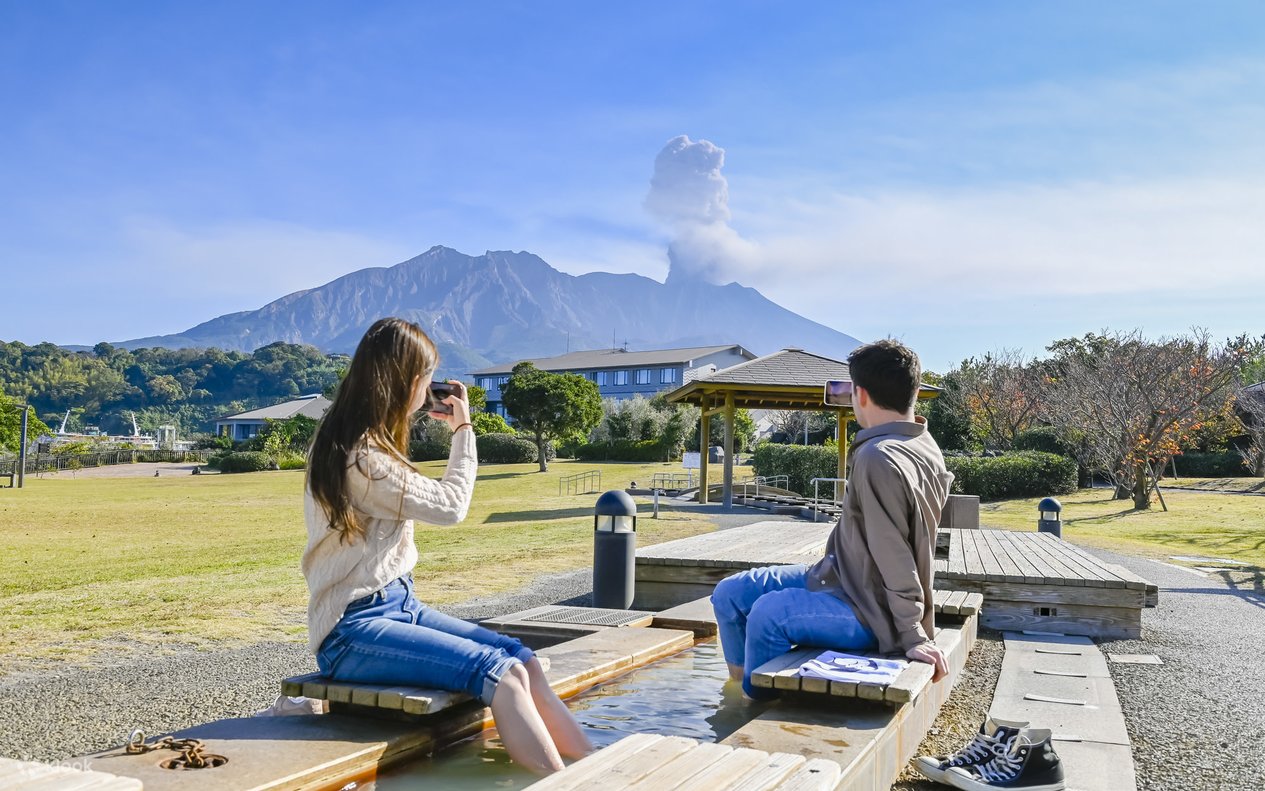
Board the ferry from Kagoshima Port and watch Sakurajima grow closer across the bay. The crossing takes about 15 minutes. On the island, stop at the Sakurajima Visitor Center to learn about eruptions, then relax at the long Nagisa lava footbath overlooking the water. The Sakurajima Island View loop bus helps families reach the main stops without a rental car.
One-way fares are ¥250 for adults and ¥130 for children from age one through elementary school, and one preschool child per paying adult rides free. The ferry no longer runs 24 hours: since October 2025 it operates from about 4:00 to 23:30.
2. Make art with Sakurajima volcanic ash
On Sakurajima, local pottery studios let visitors glue coloured volcanic ash onto a sketch to make a picture, a little like painting by numbers. It only takes about 20 minutes, so it fits easily into a volcano day.
The English-guided half-day Sakurajima tour on Viator (about 4.5 hours) includes the ferry ticket and the ash-art activity, along with the Island View bus and volcano viewpoints. Lunch is not included, and infants sit on an adult’s lap.

3. Visit Sengan-en and dress like a samurai
Photo: Klook
Sengan-en is a 50,000-square-metre landscape garden built in 1658 as a villa of the Shimadzu family, with sweeping views of Sakurajima across the bay. The historic residence and the Shoko Shuseikan museum help children picture life in old Satsuma.
Children can try on replica samurai armour in child sizes, booked separately from garden admission. For something they can keep, there are easier crafts such as Satsuma ware plate painting (fired and shipped about two weeks later) and decorations made with fragments of Satsuma-kiriko glass. The full kiriko glass-cutting experience is aimed at older children, so check the minimum age.

4. Visit Io World Kagoshima Aquarium
Photo: Klook
See marine life from Kagoshima Bay and the seas of southern Japan, including a large Kuroshio tank with whale sharks. Dolphin presentations and feeding demonstrations add variety, and the upper floor has a view across to Sakurajima.
Because the aquarium is right by the ferry terminal, it fits easily before or after an island outing. Children under four enter free; from age four, children need a ticket.
5. See koalas and wildlife at Hirakawa Zoo
Hirakawa Zoo is known for its koalas, African animals and broad open grounds. It makes a good alternative to an intensive museum day, but the site is large and south of the centre, so plan breaks and allow time to get there.
6. Let children play at Sakurajima Dinosaur Park
This free public park near Sakurajima Port has dinosaur models and playground equipment. It is a practical complement to the Visitor Center for families with younger children.
7. Try Oshima-tsumugi weaving or braiding
Amami no Sato introduces traditional Oshima-tsumugi textiles through displays and experiences such as weaving, braided accessories and natural dyeing. Workshop availability and ages vary, so treat it as an optional craft stop rather than assuming daily English-language instruction.
Kirishima with kids: onsen, outdoor play and history
Kirishima is a separate stay or a long excursion, not an easy extension of a Sakurajima day. A rental car makes it much more practical to connect the park, shrine and craft experiences.
8. Ride the slider at Kirishima Shinwanosato Park
This hillside leisure park near Kirishima Shrine has a sightseeing lift, a long slider, a small road train and seasonal outdoor activities. It is easy to balance with a quieter shrine visit nearby.
9. Make fire like the Jomon people
Uenohara Jomon no Mori preserves the remains of one of Japan’s early settled communities. Alongside the archaeological exhibits, the site has offered fire-making, accessory-making and other crafts inspired by prehistoric life, a good hands-on alternative to another sightseeing stop.
10. Walk through Kirishima Shrine and enjoy a family onsen
Deep-green forest surrounds Kirishima Jingu, making it atmospheric even for children with little knowledge of Japanese history. Nearby, you can choose a hotel with a playground, private baths or a seasonal outdoor pool, depending on what your family enjoys.
11. Visit Takachiho Farm or Kirishima Open-Air Museum
Takachiho Farm has farm animals and dairy-themed activities; it is actually just across the border in Miyazaki Prefecture. Kirishima Open-Air Museum, in Yusui, has large outdoor artworks that invite exploration. Pick one based on your child’s interests and the direction of your drive.
Best day trips: Chiran, Ibusuki and Dolphin Land
These are three different directions from Kagoshima City. Rather than putting all of them on one itinerary, choose one or add extra nights.
12. Walk through Chiran Samurai Residence Gardens
Chiran’s historic samurai district has carefully maintained gardens and quiet lanes that help children picture life in old Satsuma. It is not a hands-on armour experience; save that for Sengan-en.
13. Visit the Chiran Peace Museum thoughtfully
Chiran Peace Museum preserves the photographs, letters and belongings of 1,036 army special-attack pilots sent on missions near the end of World War II. This is a solemn memorial, not an aviation theme park, and its exhibits can be emotionally difficult, especially for younger children. Older children and teenagers may benefit from preparing questions and talking about the visit afterwards.
The museum is open daily from 9:00 to 17:00 (last entry 16:30). Admission is ¥500 for adults and ¥300 for elementary and junior high school students through March 31, 2027. From April 1, 2027, admission will increase to ¥800 for adults and ¥400 for school-age children. Guided explanations, including in English, can be reserved, and an audio guide is available.
14. Ride the Ibusuki no Tamatebako and try rotating somen
JR Kyushu’s black-and-white Ibusuki no Tamatebako sightseeing train runs between Kagoshima-Chuo and Ibusuki, with reserved seats only. In Ibusuki, try Tosenkyo’s rotating somen-nagashi: noodles travel around a circular bowl of cold spring water, so eating becomes part of the fun. Ibusuki is also known for hot sand baths, but age and health rules vary by facility.
15. Meet dolphins at Shibushi Bay Daikoku Dolphin Land
Daikoku Dolphin Land in Kushima, Miyazaki Prefecture, offers dolphin presentations and optional encounter programmes that cost extra.
It is not close to downtown Kagoshima. Treat it as a dedicated excursion on a road trip through the Osumi Peninsula or southern Miyazaki.
Where to eat Kagoshima local food with kids
Start with kurobuta (local black pork), tonkatsu (crispy pork cutlets), satsuma-age (fried fishcakes), keihan (Amami-style chicken and rice soup) and shirokuma shaved ice. Some traditional restaurants focus on dinner and serve alcohol, so a private room or an early booking helps with young children.
| Restaurant / stop | Try | Why it works for families | Area |
|---|---|---|---|
| Kurokatsutei Chuo Station | Black-pork tonkatsu | About 6 minutes’ walk from the station, with a kids’ set, table seats and private rooms | Kagoshima-Chuo |
| Kumasotei | Kurobuta shabu-shabu and Satsuma dishes | Local-cuisine specialist with an English menu and private rooms; lunch courses are easier with children. Reserve on byFood | Tenmonkan |
| Wakana (Tenmonkan) | Miso oden, black pork, local dishes | Wide choice of local specialities; reserve suitable seating | Tenmonkan |
| Tosenkyo Somen Nagashi | Rotating somen noodles | The meal becomes an activity | Ibusuki (day trip) |
| Shirokuma shaved ice | Milk-flavoured shaved ice with fruit | A local dessert children will love | Tenmonkan and elsewhere |
“Children welcome” in a directory does not guarantee a high chair, changing table, English menu or private room. Confirm with the restaurant, and ask about smoking policies and set courses.
Book Kagoshima food in English on byFood
For a tea experience or a black-pork meal outside the city centre, byFood handles the booking in English.
A 1.5-hour small-group tasting of organic teas from Kirishima, with wagashi sweets and a chance to whisk your own bowl of matcha. Better for school-age children who can sit through a tasting.
A black-pork restaurant a few minutes by car from Kirishima-Jingu Station, useful for lunch on a Kirishima day.
Booked through byFood, a Japan food-experience platform with English support. Check each listing for children’s pricing, minimum age and allergy handling before you book.
What to buy in Kagoshima with kids: 10 local souvenirs
There is more to Kagoshima shopping than sweets. Look for crafts connected to Satsuma history and edible souvenirs made from sweet potatoes, brown sugar and citrus.
| Souvenir | What makes it special | Where to look |
|---|---|---|
| Satsuma-age | Traditional fried fishcakes; check refrigeration needs | Kagoshima-Chuo, Tenmonkan, local producers |
| Karukan | Soft steamed sweet made with Japanese yam and rice flour | Confectioners and station shops |
| Satsuma sweet-potato sweets | Baked or packaged treats made with local sweet potatoes | Station shops and souvenir stores |
| Shirokuma-themed sweets | Playful souvenirs inspired by the city’s shaved-ice dessert | Tenmonkan and city souvenir shops |
| Satsuma-kiriko glass | Distinctive cut glass; choose small, securely packed pieces | Sengan-en and the neighbouring glassworks shop |
| Satsuma ware | Decorated pottery, or a plate painted at a workshop | Sengan-en and pottery studios |
| Oshima-tsumugi accessories | Small woven or braided items made with the famous textile | Amami no Sato and craft shops |
| Volcanic-ash artwork | A Sakurajima memory children can make themselves | Sakurajima studios |
| Kagoshima tea | A compact present for tea-loving family members | Tea shops and station stores |
| Sakurajima daikon and citrus products | Local pickles, sweets and seasonings | Sakurajima roadside shops and station stores |
Fresh fishcakes and some sweets do not travel as well as dry packaged snacks. Check ingredients, allergens and your home country’s import rules before taking food overseas.
Where to stay in Kagoshima with kids
For first-time visitors, Kagoshima City is the most flexible base. Stay in Kirishima if you want an onsen resort and time for outdoor activities. Check room occupancy with your children’s actual ages: some Japanese hotels charge extra for bedding and meals, even when a child shares a bed.
SHIROYAMA HOTEL kagoshima
A long-established hotel on Shiroyama hill with an open-air natural hot-spring bath overlooking Sakurajima and the bay, plus several restaurants. A free bus runs between the hotel, JR Kagoshima-Chuo Station and the Tenmonkan shopping area.
Family rooms are available. Seasonal children’s programmes have run in the past, but do not assume they operate year-round.
Sheraton Kagoshima
Sheraton Kagoshima is located beside the Takenohashi tram stop, about 10 minutes from Kagoshima-Chuo Station by the hotel’s complimentary shuttle bus. The shuttle makes it convenient for families arriving by Shinkansen, even though the hotel is not directly beside the station. Shuttles run about every 30 minutes and cannot be reserved.
The hotel has a natural hot-spring bath with an open-air section and sauna, several restaurants and a buffet breakfast.
Confirm cot availability, maximum room occupancy and whether children can use the spa facilities.
Kagoshima Sun Royal Hotel
A family-friendly option with a 13th-floor hot-spring bath overlooking Kagoshima Bay toward Sakurajima. A free shuttle connects the hotel with JR Kagoshima-Chuo Station and Tenmonkan.
Triple rooms are available. Check the current shuttle timetable and child bedding rules.
Kirishima Kokusai Hotel
One of the hotel’s biggest advantages for families is Kirishima Kids Park, an indoor play area divided into three age-based zones: a baby area for infants under one, pretend-play activities for children aged approximately one to six, and an active play area designed mainly for ages four to seven. Children must be accompanied by an adult.
The hotel is about 30 minutes by car from Kagoshima Airport and 20 minutes from Kirishima Shrine. It has a range of hot-spring baths, including mud baths, and private baths can be reserved for an extra charge. The Kids Deluxe room sleeps up to six, and staff can warm baby food or milk you bring if you ask in advance.
Cots and extra beds are not available, so check the room layout for younger children. To be served dinner, check in by 18:00.
LA VISTA Kirishima Hills
A hilltop resort near Maruo Falls where each room has its own natural hot-spring open-air bath, a good choice for families who prefer private bathing. There is also a seasonal outdoor pool.
Check the exact room layout, the bath’s water temperature and child policies before booking.
Ibusuki Hakusuikan
Overlooking Kagoshima Bay, Hakusuikan has spacious hot-spring baths, an on-site sand bath and an outdoor pool, with Japanese-style rooms. A free shuttle runs from JR Ibusuki Station at set times.
It makes sense if your family chooses Ibusuki as an overnight stay rather than a rushed day trip. Tell the hotel your children’s ages when booking; meals and extra bedding for children may cost extra.
Sample Kagoshima family itineraries
Day 1: Sengan-en and a craft activity, then black-pork tonkatsu and shirokuma in Tenmonkan.
Day 2: Sakurajima ferry, Visitor Center and footbath, then the aquarium if the children still have energy.
Day 1: Sengan-en and Kagoshima City.
Day 2: Sakurajima and ash art.
Day 3: Kirishima Shrine, Shinwanosato Park and an onsen resort.
Add a dedicated day in Chiran for the samurai gardens and Peace Museum, keeping the museum optional for younger children. Spend the extra night in Kirishima or Ibusuki.
If you are already driving through the Osumi Peninsula or southern Miyazaki, consider Dolphin Land. Do not try to combine it casually with a Sakurajima or Chiran day.
Practical tips for visiting Kagoshima with children
Kagoshima City has trams and buses. The Sakurajima ferry and Island View bus work well without a car; Kirishima, Chiran and Dolphin Land are much easier by car.
Ashfall can irritate eyes and airways. Follow local alerts, avoid restricted areas, and do not assume the weather is the same on both sides of the bay.
The aquarium and many city sights are easier than shrines, hilly parks and stone-paved samurai streets.
Ask whether a hotel accepts children who are not toilet-trained in communal or private baths, and check any pool or sand-bath age rules.
Minimum age, language, materials and shipping fees vary. Ask whether finished pottery can be collected or shipped before you leave Japan.
Report allergies directly to restaurants, especially fish, soy, eggs and wheat. Not all regional dishes are vegetarian.
Getting to and around Kagoshima: rail pass and car rental
Hakata to Kagoshima-Chuo by Shinkansen costs about as much each way as half the All Kyushu pass (3 days ¥22,000), so a pass pays off if you also visit Kumamoto or Fukuoka. Children aged 6–11 pay half price.
Kirishima, Ibusuki’s quieter beaches and Chiran are much easier by car. Pick one up at Kagoshima-Chuo or Kagoshima Airport. Request child seats when you book; they are required by law for children under 6.
Until February 28, 2027 (or until the budget runs out), Kagoshima Prefecture and Klook cover a one-way Hakata–Kagoshima-Chuo Shinkansen fare, up to ¥11,420, for residents of the US, Singapore, Thailand, Vietnam, Korea, China, Taiwan and Hong Kong who arrive via Fukuoka Airport and book a Kagoshima stay through Klook’s campaign page.
Kagoshima with kids: common questions
Yes. The ferry and short stops suit babies, although ashfall, heat and uneven paths can affect the day. Keep the plan flexible.
Not for Kagoshima City and Sakurajima. A car is far more useful for Kirishima, Chiran and the dolphin attraction in Miyazaki.
It is best approached as a serious history visit for older children or teens. Parents should decide based on the child’s maturity and comfort with emotionally difficult wartime material.
No. Shibushi Bay Daikoku Dolphin Land is in Kushima, Miyazaki Prefecture, and needs a substantial detour from Kagoshima City.
The full glass-cutting experience is aimed at older children, so check the minimum age. Younger children can try easier crafts such as kiriko-fragment decorations or Satsuma ware painting.
Black-pork tonkatsu, karukan sweets, fishcakes and shirokuma shaved ice are easy starting points. Rotating somen in Ibusuki is especially fun as a food experience.