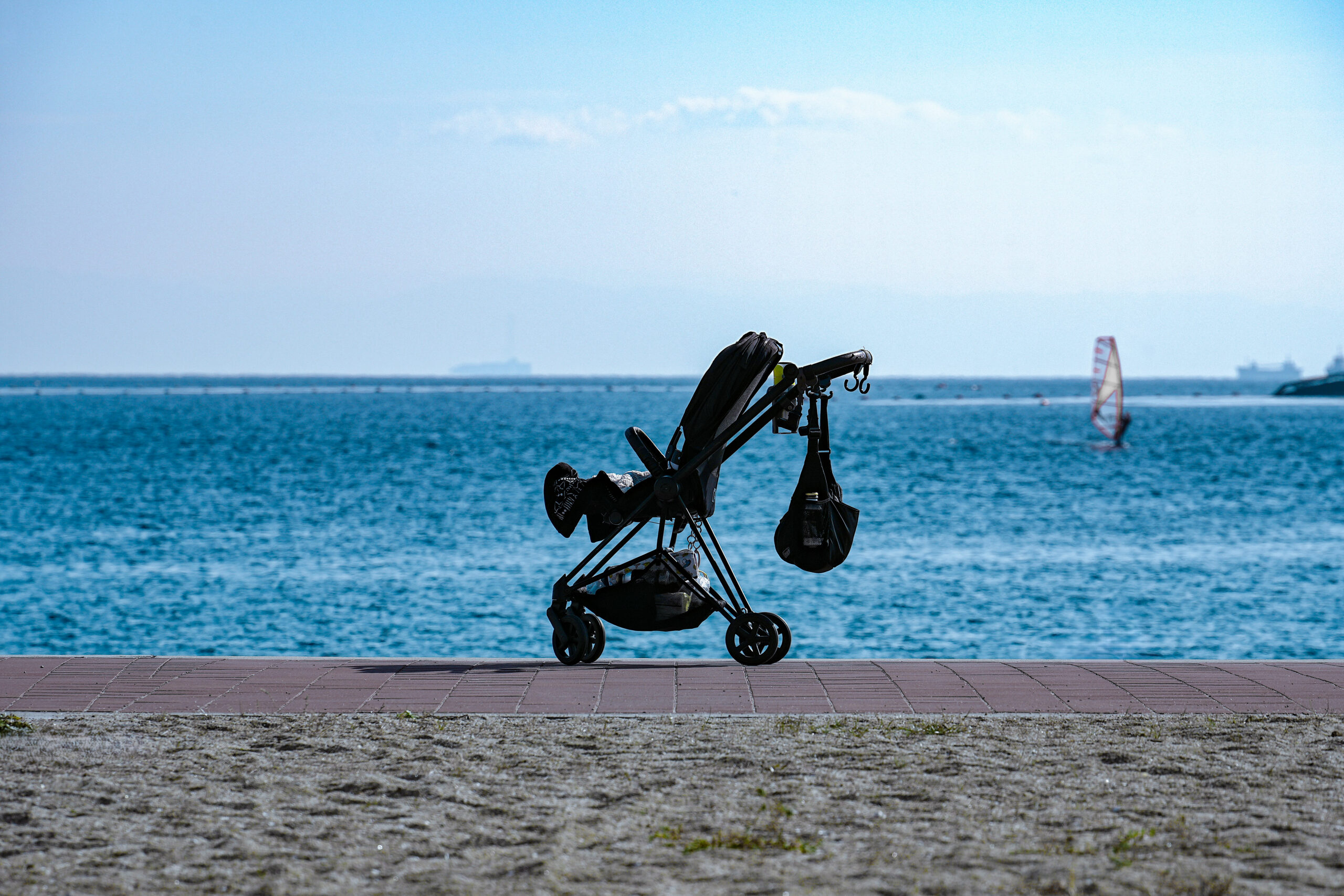
Do You Need a Stroller in Tokyo? What Parents Actually Need to Know
Tokyo is very manageable with a stroller, but the answer changes depending on your child’s age, how much they normally walk and what kind of days you are planning.
Some links in this guide are affiliate links. If you book through them, Japan Kids Travel may earn a commission at no extra cost to you.

For a baby or child under three, I would bring a stroller. For ages three and four, I would usually still bring one. At five, it depends on the child and the itinerary. By six, most families can manage Tokyo without one unless the child tires easily or you are planning exceptionally long days.
The reason is simple: Tokyo sightseeing involves a lot of walking. A child who happily walks around the neighborhood at home may be much less enthusiastic after a morning at a museum, several train transfers and a long walk through a station.
At the same time, a stroller is not always convenient. Elevators can send you on a longer route, small restaurants may have nowhere to put one, and crowded stations are much easier with something compact.
Should you bring a stroller to Tokyo? My default by age
Useful for naps, long walking days and carrying some of the extra baby gear you inevitably accumulate.
Many children this age can walk a lot — until suddenly they cannot. Tokyo days are long.
Think about stamina, naps, theme parks and whether you routinely stay out from morning until evening.
Most school-age children can manage without one, although individual stamina matters more than the birthday.
Stroller or baby carrier? For younger children, I would bring both
With a baby, the stroller-versus-carrier question does not need to have one answer. A lightweight baby carrier is a useful backup, even on days when you’re planning to use a stroller. It makes it easy to change plans when stairs, crowds or a tiny restaurant get in the way.
| Stroller | Baby carrier | |
|---|---|---|
| Long walks | Much easier | Tiring for the adult |
| Naps | Very useful | Depends on the baby |
| Stairs | Annoying | Easy |
| Crowded trains | Can be awkward | Much easier |
| Small restaurants | May need to park outside | Easy to carry in |
| All-day sightseeing | Very useful | Better as backup |
For babies and younger toddlers, my ideal combination is a compact stroller for the bulk of the day and a carrier tucked underneath it for the awkward parts.
What using a stroller in Tokyo is actually like
Tokyo is not a stroller nightmare. The city has extensive elevators and accessible routes, and local families use strollers every day.
The inconvenience comes from the route rather than the destination. The nearest station exit may have stairs, while the elevator is at the opposite side of the platform. A five-minute transfer without children can become fifteen minutes when you follow the step-free route.
Do not assume the fastest route on the map is the easiest route with a stroller. A slightly longer route with one elevator is often much better than a shorter route involving stairs, narrow exits and multiple changes.
Trains and subways with a stroller
Tokyo trains and subways
Outside the busiest commuter periods, I find trains much easier with a stroller than many visitors expect.
JR East explicitly allows passengers to board with a stroller unfolded, although you should keep control of it and be considerate when the train is crowded.
The bigger issue is not the train itself. It is finding the correct elevator through large stations such as Shinjuku, Tokyo and Shibuya.
The real challenge: elevators inside Tokyo stations
Tokyo Metro has completed at least one step-free route from street level to ticket gates to platforms at all 180 of its stations, using elevators, ramps or other accessible equipment.
That does not mean every entrance has an elevator. This distinction matters enormously when you have a stroller.
- Look for the elevator before choosing your exit. The most obvious staircase may not be the route you need.
- Do not blindly follow the nearest exit number. A different exit with an elevator can be far easier even if it adds a few minutes outside.
- Ask station staff. Staff can tell you which elevator route connects to the platform you need.
- Allow extra time for transfers. The accessible route may involve a different corridor or elevator bank.
Do not use an escalator with a child sitting in the stroller
Tokyo Metro asks stroller users to fold the stroller when using an escalator. With a baby or toddler, use the elevator whenever possible.
If you reach stairs and cannot find the accessible route, ask station staff rather than attempting to carry a loaded stroller down an unfamiliar staircase.
Use the wheelchair-accessible route in Google Maps

This is one of the simplest things you can do to make Tokyo easier with a stroller.
- Search for your destination.
- Choose Directions.
- Select public transit.
- Open route options.
- Select Wheelchair accessible.
- Compare that route with the fastest route before leaving.
It is not a perfect guarantee that every meter of the journey will be effortless, but it is much more useful than discovering at the bottom of a staircase that the elevator was two exits away.
Can you take a stroller on Tokyo buses?
You do not always need to fold it
On Toei buses, a child can remain in a stroller when the stroller is secured using the belt provided in the designated wheelchair and stroller space. Each bus has two of these spaces.
If both spaces are already taken, you will be asked to fold the stroller or wait for the next bus. You may also be asked to fold it if conditions make unfolded use impractical.
I still prefer trains or taxis when both are equally convenient. Buses involve narrower aisles, more movement and less space, which can be awkward with a stroller and luggage.
Taking a stroller on the Shinkansen

You do not automatically have to fold a stroller simply because you are taking a Shinkansen.
On the Tokaido, Sanyo and Kyushu Shinkansen, travelers with very large suitcases (total dimensions over 160cm) must reserve a seat with oversized-baggage space. Strollers are exempt from that rule regardless of size. If you specifically want to use the reserved space behind the last row, reserve a seat that includes it.
On JR East Shinkansen lines (Tohoku, Joetsu, Hokuriku and others), there is no oversized-baggage reservation system. Use the luggage areas where available, or keep the stroller at your feet.
Reserving a seat with extra baggage space can still be a very good idea. The point is that the stroller itself does not automatically force you to make that reservation.
Taxis and private transfers in Tokyo with a stroller
Tokyo has excellent public transport, but a taxi can save a surprisingly difficult final leg of the day. If your toddler has fallen asleep, it is pouring, or the route back to your hotel means two transfers, I would at least compare the taxi option before heading back underground.
Taxis are especially useful on rainy days and hot summer days. Try to take one before the kids are completely worn out, not after. That said, taxis can be hard to catch exactly when you need one, especially in the rain. If you have been waiting a while, the train is often the faster option, and a baby carrier makes that switch much easier.
You do not necessarily need a taxi app. In busy central areas, you can usually flag down a taxi on the street. Look for the red 空車 (kusha) sign, which means the taxi is available. Taxi stands are also common outside major stations and hotels. Taxis are harder to find in residential neighborhoods, on smaller streets and in the rain.
Many Tokyo taxis accept credit cards and IC cards like Suica as well as cash. Payment options vary by vehicle, so check the stickers on the door or ask the driver if you plan to pay by card.
Useful taxi apps
GO: Japan’s most widely used taxi app. It works with overseas phone numbers and international credit cards. In Tokyo, an app fee is added to the meter fare, and short-term visitors also pay an International Service Charge. You can see the total on the fare details screen before you book.
Uber: Familiar to international visitors. In Tokyo, it connects you with licensed taxis rather than private drivers.
DiDi: Another option in Tokyo and other major cities, useful as a backup.
If you see an available taxi on the street, there is usually no need to open an app. But installing one before you arrive helps when you are waiting with a tired child.
Private airport transfers with kids
With a stroller, suitcases and a tired child after a long flight, a pre-booked private airport transfer can be worth considering. If your hotel is near a direct airport train and you can manage your bags, the train may still be easier.
Klook offers private airport transfers for Haneda and Narita. Check vehicle capacity, child seat availability, how the stroller counts toward your luggage allowance and pickup instructions before booking.
Where a stroller becomes annoying in Tokyo
A restaurant can allow children and still have no physical space for an open stroller.
Shinjuku and other major interchange stations can require long detours to stay on elevator routes.
Gravel, steps and uneven stone surfaces can make a carrier much easier.
The issue is less about formal rules and more about having almost no comfortable space.
Some attractions require stroller parking or are simply easier once the child is out of the stroller.
A stroller loaded with shopping becomes much harder when you suddenly need to fold it.
Tokyo areas that are easier with a stroller
| Area | Why it works | Main caution |
|---|---|---|
| Tokyo Station / Marunouchi | Wide modern buildings, elevators, department stores and family facilities | Tokyo Station itself is enormous |
| Ginza | Department stores, elevators and relatively straightforward streets | Smaller restaurants can be tight |
| Toyosu / Ariake | Modern, wide and built around large family attractions and malls | Distances can be longer than they look |
| Odaiba | Wide walkways, malls, family facilities and modern stations | Some attractions require stroller parking |
| Oshiage / Skytree | Skytree Town puts shops, food, aquarium and baby facilities together | Can become crowded on weekends |
| Ueno | Park space, museums and zoo close together | Some slopes and outdoor walking |
Areas where I would allow extra time
Perfectly possible with a stroller, but enormous. Know which side of the station you actually need before choosing an exit.
Elevators exist, but crowds, slopes and ongoing changes around the station can turn a short route into a more complicated one.
The wider neighborhood is manageable, but the busiest approach around Senso-ji can become dense with pedestrians.
Flat city streets may be easy while the final shrine or temple grounds involve steps, gravel or uneven surfaces.
What kind of stroller works best in Tokyo?
- Compact rather than huge. Narrow station corridors, small elevators and restaurants reward a smaller footprint.
- Light enough to lift when necessary. Even with good planning, you may eventually meet a few steps.
- Easy to fold. One-hand folding is genuinely useful when you are also managing a child.
- A decent recline. If your child still naps, this matters more than having a giant basket.
- Good enough wheels for long walking days. Tokyo sidewalks are generally good, but you may push the stroller for many miles.
- Do not overload the handles. Heavy shopping bags hanging from the back can make a stroller unstable, especially when the child gets out.
What about a double stroller?
A double stroller is possible in Tokyo. I would not tell a family with two small children that they simply cannot bring one.
But it changes the trip. Narrow elevators, restaurant entrances, busy station corridors and buses all become more complicated. If you have a choice between an especially wide side-by-side model and a narrower tandem design, width matters in Tokyo.
Bring your own stroller or rent one in Tokyo?
| Bring from home | Rent in Tokyo | |
|---|---|---|
| Best for | Babies, daily stroller users, long trips | Older toddlers, occasional use, families packing light |
| Child familiarity | Excellent | Unknown until you try it |
| Airport | You have it immediately | Depends on rental method |
| Flying with it | Extra item to manage | No stroller on the plane |
| Model choice | You already know it | Can choose a compact travel model |
| Cost | No rental cost | Can add up on longer stays |
Where to rent a stroller in Tokyo
Klook – Bugaboo stroller rental with hotel delivery
Choose a 3–7 day rental and have a Bugaboo stroller delivered to your hotel in Tokyo. Two-way delivery is included, so this suits families who want a stroller for several days rather than a quick hourly rental.
Babycal
Babycal is useful when you only need a stroller for part of the trip or even part of a day. It is run by the JR East Group, with rental spots at stations, hotels, commercial facilities and Haneda Airport.
Current pricing (revised July 2026) is ¥250–¥500 for the first hour, then ¥150 per additional 30 minutes, with a 12-hour maximum of ¥2,000. Rates vary by location and stroller, and the estimate is shown before you book.
You register and reserve online, and a credit card is required. Rentals range from an hour to several days depending on availability, and you return the stroller to the same spot.
Sakura Stroller Rental
This is more useful for families who want one stroller for several days rather than hourly rental.
Sakura offers compact models including Cybex Libelle, Cybex Orfeo, Babyzen YOYO, Aprica models and a double stroller. Delivery and pickup can be arranged at hotels, Airbnbs and other locations, with English support available.
StrollerTrip
StrollerTrip rents Combi strollers and can deliver to hotels or another requested location in central Tokyo, as well as to Haneda and Narita airports.
The rental itself may be reasonably priced, but delivery charges vary significantly by area, so compare the complete price rather than only the daily stroller fee.
Department-store stroller loans
Large department stores and shopping malls often provide stroller loans for use inside the facility.
These are very useful for a shopping afternoon, but they are not a replacement for a travel stroller because the stroller generally needs to remain within that property.
When I would leave the stroller at the hotel
- Your child is four or five, normally walks long distances and you are staying within one compact neighborhood.
- You are visiting a temple or older attraction where stairs and uneven ground will dominate the day.
- You expect to eat in several small restaurants and the child no longer naps.
- You are doing a short morning outing and returning to the hotel after lunch.
- You know the child will happily use a carrier instead.
My practical rules for Tokyo with a stroller
- Check the wheelchair-accessible route before entering a large station.
- Avoid trains on weekday mornings and evenings when you can.
- With a baby or young toddler, pack a lightweight carrier as backup.
- Keep the stroller light enough to fold quickly, without heavy bags on the handles.
- Take a taxi before everyone is exhausted, not after.
Tokyo stroller FAQ
Yes. Babycal has rental spots at Haneda Airport, and StrollerTrip can deliver to Haneda or Narita. If you would rather have the stroller waiting at your hotel, Klook’s rental delivers there.
Generally not. Taxis are legally exempt from Japan’s child seat requirement, so if you want one, arrange it in advance with the operator.
Yes. GO, Uber and DiDi all work in Tokyo. GO adds an app fee and an International Service Charge for short-term visitors, shown before you book.
You can, but it is uncomfortable for you and other passengers. If your schedule allows, travel outside weekday 7–9am and 5–7pm.
The bottom line
Under three, bring a stroller. At three or four, usually bring one. At five, decide based on your child rather than their age. Choose something compact and easy to fold, and with a baby or young toddler, add a carrier for the moments a stroller can’t handle.
Planning Tokyo with kids?
Start with your child’s age, how much walking they can realistically handle and where you are staying — then build the itinerary around that.